Sep 28, 2026
league scheduling software, golf tournament management, sports league software, live scoring platforms, roster management tools
Compare top league scheduling software features, pricing, and workflows. Discover how modern platforms streamline golf tournaments and league management.

The night before league play, a head professional is often doing far more than checking tomorrow's tee sheet. A player has withdrawn, a substitute needs adding, a course date has shifted, and someone has edited a spreadsheet that now disagrees with the email sent to the field. By morning, staff are reconciling versions instead of preparing the course.
That friction is the hidden cost of legacy scheduling tools. Manual rescheduling, spreadsheet cleanup, and app-download requirements consume staff time and create avoidable work for players. Modern league scheduling software moves more of that burden into a cloud platform that can generate schedules, check constraints, publish changes, and keep standings current from one place.
The category is expanding with the wider sports league management software market. One recent projection puts that market at USD 1.44 billion in 2026, growing at a 10.32% CAGR to USD 2.65 billion by 2032, while scheduling and management represented over 30% of global revenue in 2023 according to Research and Markets' sports league management software overview. The exact market boundaries vary between reports, but the operational conclusion is clear. Scheduling isn't a side feature anymore. It sits at the center of league administration, facility use, communication, and player engagement.
Managing League Schedules Today: Where Spreadsheets Break
A league schedule can look finished until a player withdraws, a substitute steps in, or course maintenance closes a tee window. At that point, the administrator is no longer managing fixtures. They are reconciling changes across a roster, spreadsheet, calendar, printed sheet, inbox, and player message thread.
One missed update can send a player to the wrong tee, leave a pairing unchanged, or produce standings that no longer match the results. The cleanup often falls to the pro shop on tournament day, when staff should be checking the course and supporting players.
Practical rule: If staff must compare a spreadsheet, an inbox, and a message thread to identify the current fixture, the schedule is not under control.
League scheduling software should function as an operating system for the season, rather than a digital calendar. Player records, registrations, payments, pairings, results, standings, and notifications need to draw from the same underlying data. Then an administrator changes the event once, instead of rebuilding every document that depends on it.
Legacy tools also create friction for players. Requiring a specialized app download can delay access to a revised tee time, especially when a player is responding from a phone shortly before play. A browser-based, app-free schedule gives the field a current link, while constraint-aware software can check availability and league rules before staff publish a change.
The move from paper calendars and spreadsheets to cloud platforms is well established. One industry overview reports that more than 42,000 sports organizations across 64 countries had integrated digital league management platforms by 2024. The same league management software analysis reports over 2.3 million athletes registering digitally, mobile adoption rising 22% year over year, and cloud deployment representing 61% of market usage. These figures come from one industry overview, so they provide context rather than a complete market measure.
For golf operators, the practical benefit is control. A head professional can adjust a fixture from the office, shop, or first tee, give players the current information without an app download, and spend less time repairing spreadsheets before play begins.
Core Features to Evaluate in Scheduling Platforms
Basic calendar generation is easy. Reliable scheduling starts when the platform understands the rules behind the calendar.

Constraint-aware scheduling
Advanced systems can solve for fairness, efficiency, venue availability, travel distance, team preferences, and division balance at the same time. That matters in multi-division leagues and facilities with several playing areas, where surface type, lighting windows, capacity, and maintenance blocks can affect the result.
A simple tool may catch one double booking. A constraint-aware engine considers the entire schedule before publishing. It can identify overlapping team slots, insufficient rest, unavailable venues, or an uneven distribution of home and away assignments before staff begin manual cleanup. The league scheduling features comparison from Fastbreak is useful for understanding why simultaneous constraint handling is more valuable than fixing conflicts one at a time.
Integrated registration and communication
Scheduling data should flow directly from registration and roster records. If the platform requires staff to export a list, reformat it, and upload it into a separate scheduler, the organization is still paying for manual data transfer.
Look for a workflow that combines registration, booking, communications, and schedule publication. Players should be able to submit details, view assignments, and receive updates without staff repeating the same work in several systems. The same principle applies outside sport. A resource on tutoring scheduling software shows how appointment-based organizations use centralized availability and booking workflows to reduce coordination overhead.
Table-stakes schedule formats
A serious demonstration should include the formats your league runs. Core capabilities commonly include:
Round robin: Every team or participant meets the others according to the selected league structure.
Elimination formats: Single, double, and triple elimination brackets should attach cleanly to the qualifying stage.
Swiss-system scheduling: Useful when participants need structured rounds without a traditional full round robin.
Home and away balancing: The engine should manage venue assignments without leaving staff to repair patterns manually.
Playoff attachment: Postseason fixtures should use standings or qualification results rather than requiring a new system.
Offline printing: The platform still needs printable sheets for players and staff who want paper at the course.
Real-time standings: Results should flow into the current table without delayed spreadsheet updates.
Before a purchase, compare the platform's actual golf workflows with the guidance in this golf league management software resource. Ask the vendor to build a sample season using your own rules, not a simplified demo dataset.
Comparing Legacy Systems and Modern Cloud Platforms
Legacy systems often remain in place because staff know how to use them, not because they work well. A familiar interface can still require hours of configuration, specialist training, and repeated spreadsheet exports. Modern cloud platforms usually trade some of that historical complexity for a simpler setup and a more direct player experience.
Feature Category | Legacy Incumbents | Modern Cloud Platforms |
|---|---|---|
Setup | Manual configuration, templates, and staff training | Guided setup with reusable league records |
Schedule changes | Edit several records and redistribute files | Update centrally and notify affected players |
Player access | May require a dedicated application or account workflow | Browser-based access through a link |
Live scoring | Often dependent on downloads or separate modules | Frequently available directly on mobile web |
Registration | Separate imports and roster cleanup | Connected registration and player records |
Standings | Manual result entry or delayed synchronization | Real-time updates tied to published results |
Support | Formal tickets, documentation, or paid onboarding | Often includes direct product support |
Data portability | Exports may require cleanup | Cloud records with export and integration options |
The player experience decides adoption
A scheduling system only works if players use it. App downloads create a small but meaningful barrier, especially for occasional participants, guests, older members, and corporate or charity event players. Some people won't install an app for a single league event, and others will download it but never enable notifications.
An app-free platform can let players open a web link, view the schedule, enter scores, and follow results immediately. That doesn't eliminate every adoption challenge, but it removes a step that staff would otherwise have to explain and support. It also makes last-minute access easier when a player changes phones or arrives without the device used during registration.
Setup speed is an operational feature
A legacy platform may offer many options but make ordinary tasks difficult. Staff might need to configure a league, import a roster, build pairings, publish a schedule, and then recreate the same information in a player-facing module. Modern cloud software should compress those tasks into a connected workflow.
The event management software comparison from Live Tourney can help operators frame that evaluation around setup, registration, scoring, communication, and reporting rather than looking only at the schedule screen. The right question is simple: How much work remains after the schedule is generated?
Real-World Workflows for Golf League Management
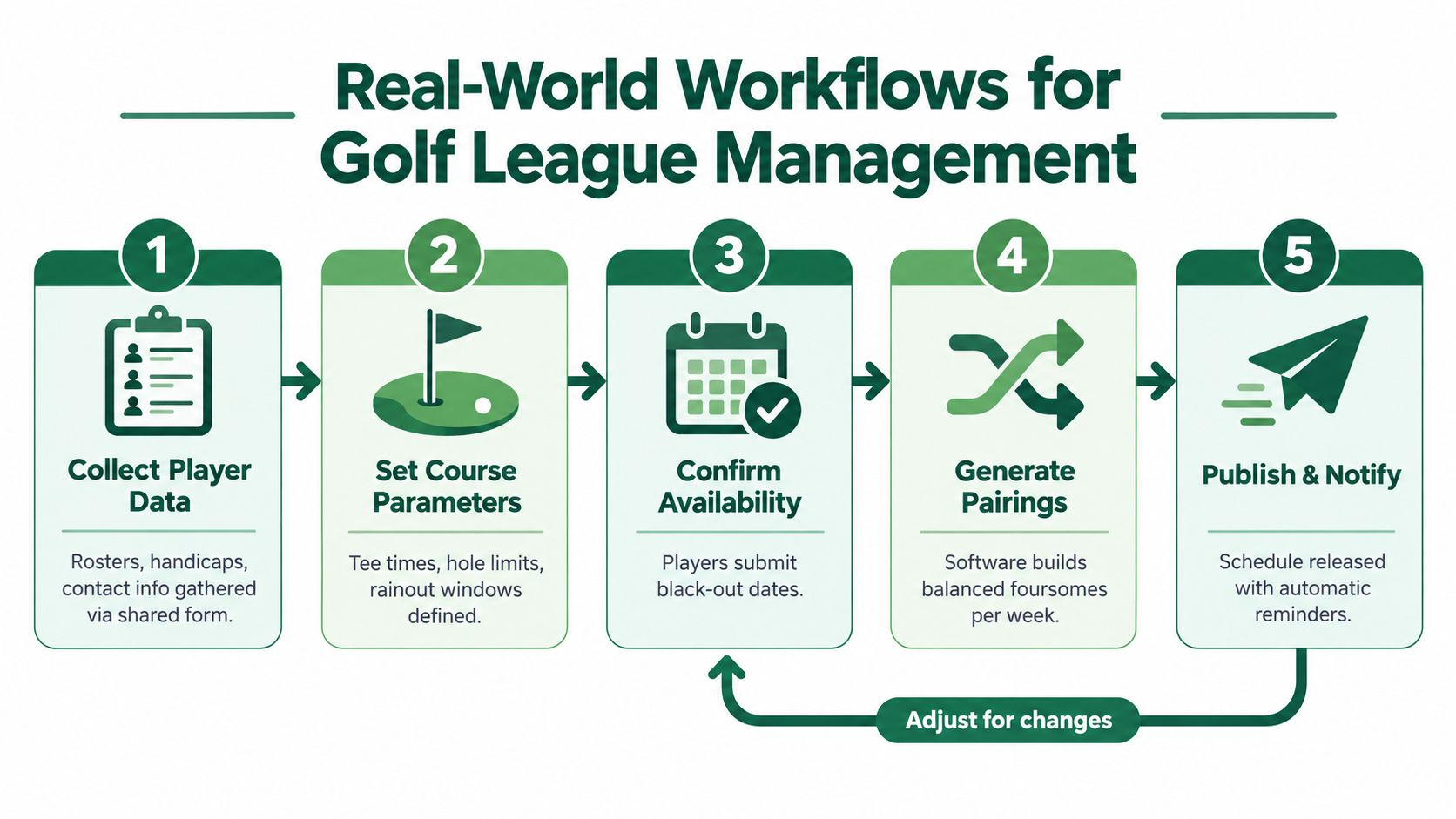
A league schedule can look correct on screen and still fail on the course. If the software does not capture eligibility, payment, availability, and competition rules before creating pairings, staff end up fixing exceptions manually and cleaning the same data in spreadsheets.
Start with the league record
Set the operating rules before generating anything:
Eligibility: Define who may enter and whether divisions or handicaps affect participation.
Dues: Record payment requirements and flag unpaid entries before publishing pairings.
Format: Set the competition structure, scoring method, and any separate stages.
Handicap method: Confirm which handicap information the league will use.
Substitutes: State who may replace an absent player and how the change affects results.
Absences: Set the notice process for withdrawals and unavailable dates.
No-shows: Publish the consequence before the first event, not after a dispute.
The LiveTourney's league management process follows this order: create the league, import the roster, verify player details, check payment status, identify substitutes, and review course dates before generating pairings. That sequence reduces rework because staff resolve incomplete records before they reach the tee sheet.
Verify the roster before building pairings
Imported names still need a practical review. Check spelling, contact information, divisions, handicap records, payment status, and substitute eligibility. One incorrect player record can affect the tee sheet, scorecard, standings, and communications.
Review course dates and tee windows at the same time. A schedule may fit the field yet fail against maintenance closures, shotgun requirements, blocked times, or the league's preferred playing window. Enter those constraints before generation. Otherwise, staff may spend the week manually moving players and correcting spreadsheet exports.
Generate and test the season
For a team league, a round robin allows every team to face the others an equal number of times across the season. Software or a generator can build the grid from team and week counts, while a guide to creating a round robin schedule for golf leagues explains the scheduling method. Some leagues divide the season into two halves with separate standings and winners, as described in this golf league scheduling guide.
Test representative weeks after generation. Check repeat opponents, venue balance, player availability, and the transition into playoffs. Then publish one current schedule through a browser link, with clear instructions for reporting absences and changes. That avoids forcing players to download an app to find a tee time.
Handling Rescheduling and Operational Governance
The schedule you publish on opening day is only a starting point. Weather, course maintenance, late withdrawals, and eligibility questions will test the platform after the season is underway.
Treat every change as a controlled record
When a round moves, staff shouldn't delete the old event and create a replacement from scratch. That approach can break standings links, payment records, player notifications, and historical reporting. A better system preserves the event identity, records the change, updates the active details, and shows who approved the revision.
The administrator should be able to see which players, venues, officials, and related events are affected. Automatic conflict checks are valuable, but they shouldn't hide the decision. The software should surface the issue and leave an authorized person responsible for accepting or resolving it.
Notifications need ownership
Automatic notifications are useful only when they reach the right people. A weather delay may affect players, the pro shop, marshals, starters, food and beverage staff, and anyone managing transport. Sending every internal note to every player creates noise, while sending too little leaves the field dependent on old messages.
Prioritize role-based notifications, calendar synchronization, and a visible activity history. Staff should know what changed, when it changed, and who received the update. Players should see the current tee assignment without needing to interpret an email chain.
Governance includes privacy and payments
Modern league systems also hold personal details, payment information, eligibility records, and sometimes youth participant data. Permission-based access helps limit unnecessary exposure, while secure audit trails make it easier to review administrative decisions. Privacy and payment requirements, including GDPR, COPPA, and PCI DSS, are pushing leagues toward platforms that can manage data access and transactions more carefully, as discussed in this review of sports league operations software problems.
The strongest platforms manage change as a process. They don't merely produce a neat schedule once, they preserve control when the season becomes untidy.
Evaluating Pricing and Total Cost of Ownership
The subscription price is only one part of the cost. A legacy tool may appear affordable until staff spend hours configuring events, attending training, correcting exports, answering player questions, and rebuilding schedules after a change.
Calculate the work behind the software
List the recurring tasks your current system creates:
Initial setup: How long does staff spend building the league, importing players, and configuring formats?
Schedule repair: How much time goes into correcting conflicts and rebuilding pairings?
Player support: How often do staff explain downloads, passwords, duplicate accounts, or outdated messages?
Reporting: Does the system produce scorecards, tee sheets, standings, and payment reports, or must staff format them manually?
Change distribution: Can one approved update reach everyone affected without separate copying?
A transparent SaaS model may be easier to budget when it includes support, hosting, updates, and core workflows. Older products may add onboarding fees, mandatory training, paid modules, or charges for integrations. Those costs don't always appear in the first sales conversation, so ask for a complete seasonal estimate.
Measure savings in operational terms
Avoid inventing a return-on-investment figure before you know your baseline. Instead, record the staff hours spent on a typical league setup, a weather reschedule, a roster correction, and a final report. Then compare those tasks during a trial.
Also consider player engagement qualitatively. A clean browser-based leaderboard can encourage more players to follow results, while an app requirement may reduce participation among occasional users. Better engagement can support stronger event communication and facility relationships, but the platform should prove the workflow in your own environment rather than relying on a generic promise.
The best purchase is rarely the platform with the most features. It's the one that removes the most repeated work without adding a new layer of administration.
Choosing the Right Platform for Your Facility
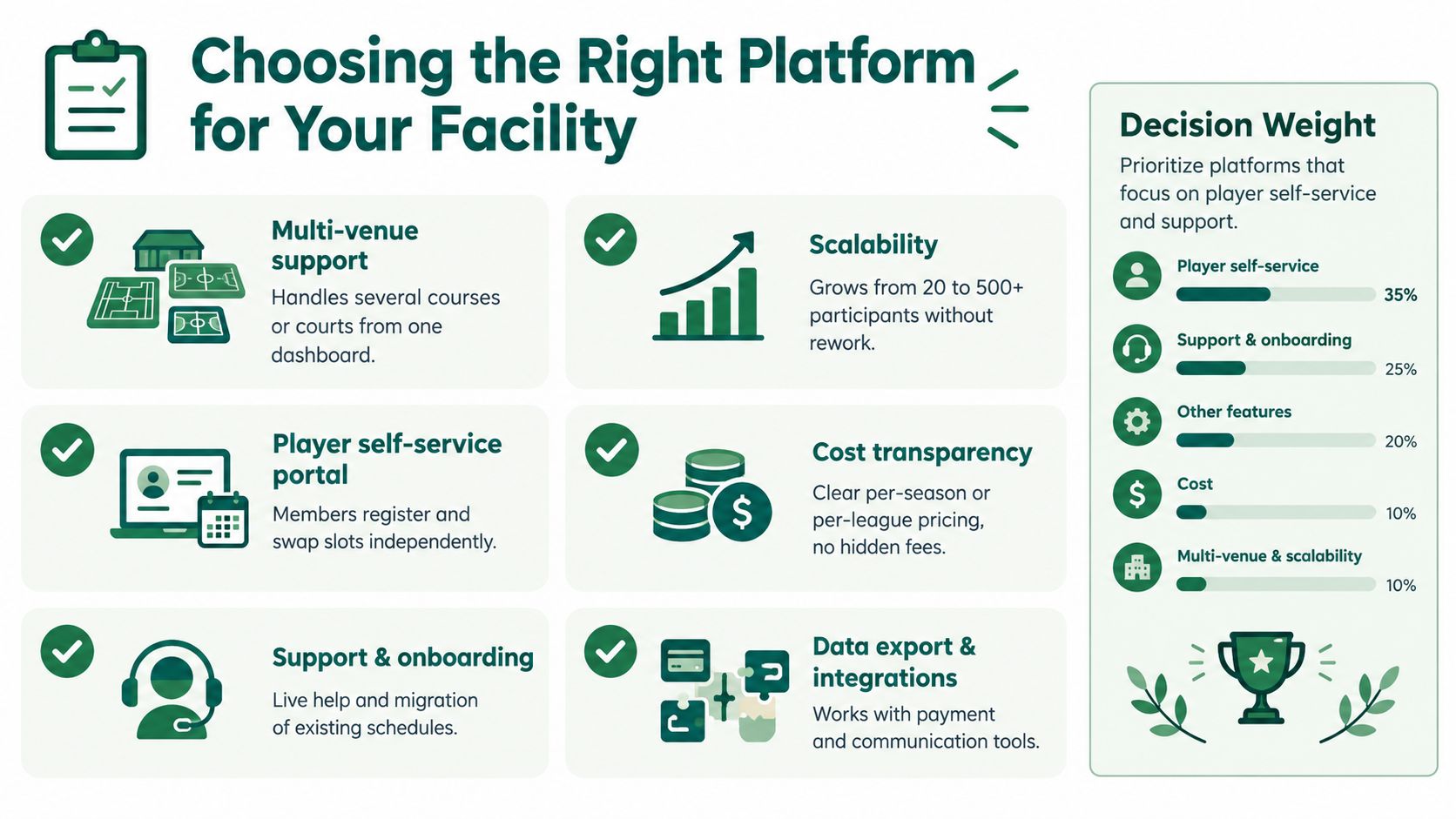
A facility should choose league scheduling software by testing the difficult day, not the polished demo. Ask a vendor to handle a late withdrawal, a blocked tee window, a substitute, a standings update, and a player who won't download an app.
Use a practical buying test
Start with setup. Can a staff member create a league, import a roster, set rules, generate pairings, and publish the first schedule without specialist training? If the vendor needs to perform every step, ask what happens when your staff must make an urgent change on tournament day.
Then test the player path. Open the schedule on a phone without downloading an app. Enter a score, view the leaderboard, check a revised tee assignment, and confirm whether the player can tell which information is current. The experience should be straightforward enough for a first-time participant.
Ask vendors direct questions
Can the engine model our rules? Test handicaps, substitutes, absences, divisions, venues, and playoffs.
What happens after publication? Look for controlled edits, conflict checks, calendar updates, and targeted notifications.
Can staff export what they need? Confirm scorecards, tee sheets, standings, reports, and payment records.
Who supports the course? Ask whether help comes from a responsive in-house team or a distant ticket queue.
What does the quote include? Clarify onboarding, migration, integrations, support, and any per-player or per-event charges.
Can we trial it with real data? A realistic test reveals more than a guided presentation.
Live Tourney is one example of a modern, browser-based option for golf facilities. It supports league organization, standings, schedules, registrations, payments, live leaderboards, roster uploads, report creation, dynamic emails, side games, payouts, and formats including match play, Ryder Cup, and round robin. Its app-free scoring model lets players access schedules and results from a link on any device, which directly addresses the download friction that often limits adoption.
Choose the platform that leaves your staff with fewer manual corrections and your players with fewer instructions. If a system can generate the schedule but can't manage the changes, it hasn't solved the operational problem.
If your facility is still rebuilding pairings in spreadsheets or asking players to download an app for basic scoring, visit Live Tourney to test a browser-based way to organize leagues, publish schedules, and keep standings live. Use the trial to run a real roster and a realistic rescheduling scenario, then compare the staff time and player experience with your current process.