Sep 25, 2026
scorecard, golf handicap, live scoring, tournament tips, golf basics
Learn how to read a scorecard like a pro. Understand par, yardage, handicap rows, and how to turn a paper card into clean live scoring on event day.

The first time you stand on a tee with a paper scorecard, it can feel like everybody else got a page of instructions and you got a puzzle. The good news is that a scorecard is built to be read in a simple order, and once you know where to look, it tells you where to play, how to record each hole, and how the round gets turned into a fair result.
What a Golf Scorecard Actually Shows You
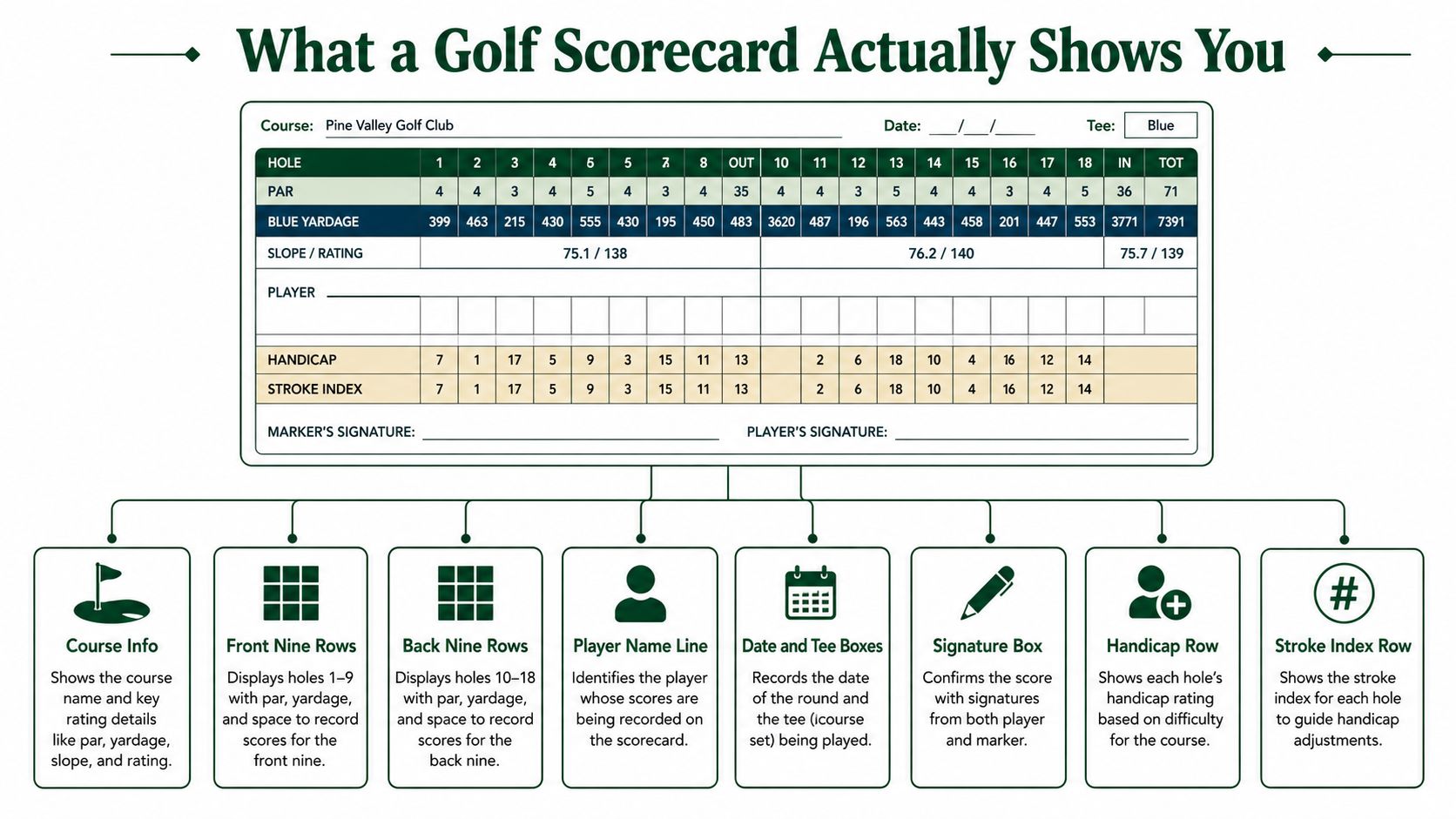
A proper golf card is more than a row of boxes. It's the sheet that ties the course, the tee set, the holes, and your scores together so the round can be tracked correctly from start to finish. The top line usually gives you the course name, sometimes the date, and often the tee color or tee name, so you know exactly which setup the round is being played from.
Under that, you'll usually see a grid from 1 to 18, one column for each hole. Across the rows, you'll find the par, the yardage for each tee set, and the handicap or stroke index row, which ranks the holes from hardest to easiest for stroke allocation. The player name line is there so the marker knows whose score is being recorded, and the bottom of the card is where the gross totals and often front-nine / back-nine totals are checked.
A second signature matters because it protects the round. The marker signs to confirm the scores, and the player signs to accept them before the card is submitted. That simple double-check keeps a tournament honest, especially when the event uses both paper and live scoring.
For a clean companion explanation, 2ndShotMVP's scorecard guide is a useful reference for the basic layout.

Practical rule: if you can point to the par row, the yardage row, and the handicap row, you can already read the core of the card.
Reading the Par and Yardage Rows
The par row is the easiest place to start. A par 3 is expected to take three strokes, a par 4 four strokes, and a par 5 five strokes. Add the pars for all 18 holes and you get the course par, which is commonly 70 to 72 on many cards, according to the standard layout described in golf scorecard references.
The yardage row tells you how far each hole plays from a specific tee set. On a standard card, you'll usually see three or four tee options, because the same hole can play very differently depending on where the round starts. A hole that shows 380 yards from a back tee might show 310 yards from a forward tee, and that changes what a player needs to hit off the tee and into the green.
That is why the tee you choose isn't just a comfort choice. Longer tees can bring carry hazards into play and make pars harder to reach in regulation. Shorter tees can turn some par 4s into manageable scoring holes, which changes the whole feel of the round.
Simple check: total yardage divided by total par gives you an easy yard-per-stroke sanity check before you write your first score.
Hole | Par | Black Tees (yds) | Blue Tees (yds) | White Tees (yds) | Red Tees (yds) |
|---|---|---|---|---|---|
1 | 4 | 410 | 385 | 360 | 330 |
2 | 3 | 185 | 170 | 155 | 140 |
3 | 5 | 540 | 510 | 480 | 450 |
4 | 4 | 395 | 370 | 345 | 315 |
5 | 4 | 430 | 405 | 375 | 340 |
6 | 3 | 160 | 150 | 135 | 120 |
7 | 5 | 560 | 530 | 500 | 470 |
8 | 4 | 405 | 380 | 355 | 325 |
9 | 4 | 420 | 395 | 365 | 335 |
Understanding the Handicap and Stroke Index Rows
The stroke index row, sometimes labeled SI or HDCP, is the ranking that tells you which holes get handicap strokes first. The number 1 marks the hardest hole, and 18 marks the easiest. That ranking exists so stroke allocation can be spread across the course in a structured way instead of being guessed hole by hole.
A player with an 18-handicap gets one stroke on every hole. A 9-handicap player gets one stroke on the nine hardest holes. A 27-handicap player still gets one stroke on every hole, plus a second stroke on the nine hardest holes because the extra strokes wrap around after 18.
A useful worked example is a 12-handicap player. That player receives one stroke on holes ranked 1 through 12 on the stroke index row, and plays holes 13 through 18 at scratch. The card's handicap row is not your personal handicap, it's the hole ranking that tells the scorer where to apply those strokes.
That distinction matters because the scorecard turns gross score into net score one hole at a time. If you don't know which holes your strokes belong on, you can't compare scores fairly in a net competition.
Item | What It Means | How to Read It |
|---|---|---|
SI / HDCP | Hole difficulty ranking | 1 = hardest, 18 = easiest |
18-handicap player | One stroke on every hole | Strokes apply on all 18 holes |
9-handicap player | One stroke on the nine hardest holes | Strokes apply on the lowest nine SI numbers |
12-handicap player | One stroke on holes 1 through 12 | No stroke on holes 13 through 18 |
Course Rating and Slope Rating Made Simple
The numbers near the top of the card look technical, but they do one clear job. Course Rating estimates the score a scratch golfer is expected to shoot from that tee set, while Slope Rating shows how much harder the course plays for a bogey golfer than for a scratch golfer. The USGA explains that 113 is the standard slope benchmark, and published slope ranges typically run from 55 to 155 USGA guidance on Course Rating and Slope Rating.
That pair of numbers matters because it helps compare different courses and tee sets fairly. The same raw score can mean something different depending on the setup, which is why a scorecard isn't just a list of holes, it's a difficulty map. If the tee row changes, the yardage changes, the context changes, and the strokes a player receives can change too.
A practical way to think about it is this, Course Rating tells you what the scratch player is up against, and Slope tells you how steep the gap is for everyone else. For handicap posting, the standard formula uses those values to turn raw play into a fair comparison, and the same logic is why tee selection matters on tournament day. If you want a deeper walk-through of that rating logic, this explanation of Course Rating is a helpful companion.
Term | Definition | Typical Range | Example Value |
|---|---|---|---|
Course Rating | Expected score for a scratch golfer | Course-specific | 71.4 |
Slope Rating | Relative difficulty for a bogey golfer versus a scratch golfer | 55 to 155 | 128 |
Standard slope | Neutral benchmark used in handicap math | 113 | 113 |
Working Through Gross and Net Scores
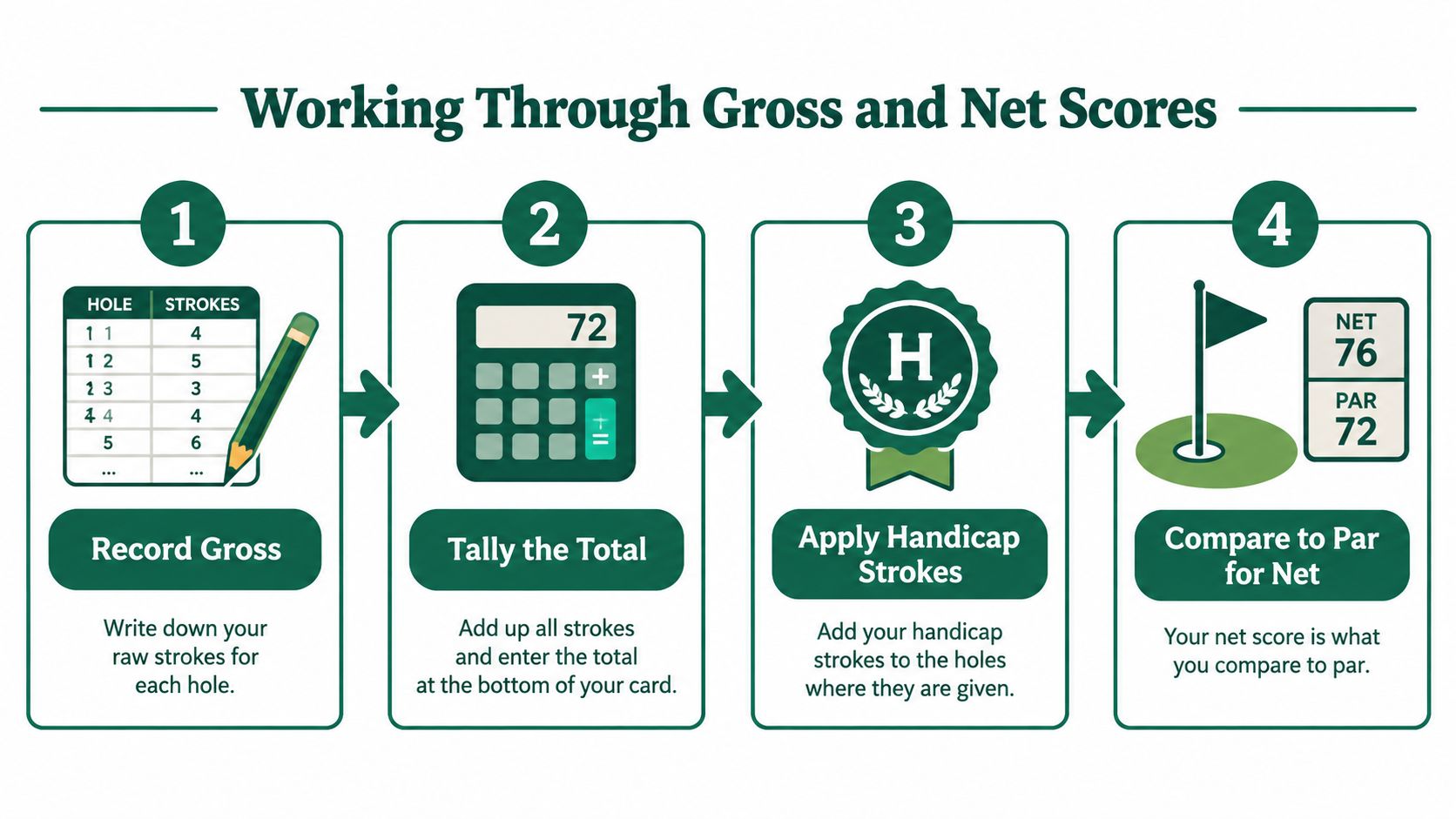
Gross score is the raw number of strokes you take. If you play a hole in five, that's a five, no adjustments, no math, just the score you posted. Net score comes after handicap strokes are applied, and that's the number used to compare players fairly in net formats.
On the card, the usual habit is to mark the strokes on the holes where your handicap applies. A player with a 12-handicap circles or notes the stroke holes that rank 1 through 12 on the stroke index row. If a course has more than 18 holes of handicap allocation for a player with extra strokes, the count wraps around to the hardest holes again.
Here's a simple nine-hole example. Say the hole scores are 4, 5, 6, 4, 5, 3, 3, 6, 4, for a gross total of 40. If four handicap strokes apply on the four hardest handicap holes among those nine, the net total drops to 36.
Penalty strokes still count. If a ball goes out of bounds, the player gets a one-stroke penalty and must replay from the previous spot under stroke-and-distance, so both the penalty and the replayed shot belong on that hole's total. After that, the marker signs, the player signs, and the card is ready to submit.
The same net-scoring logic is covered in this guide to net score in golf, which pairs well with the paper-card method above.
Moving From a Paper Card to Live Scoring
Paper and digital scoring should tell the same story. The paper card is the backup record, while the leaderboard or scoring screen gives everyone the live view. On event day, the cleanest approach is to translate each line on the card directly into the app, hole number first, then gross strokes, then any penalties or extra stat fields if the system supports them.
Enter scores as soon as the group finishes a hole. Waiting until the turn or the final green is where mistakes creep in, because a forgotten number turns into a guess later. The same discipline that keeps a paper card clean also keeps a digital leaderboard accurate.
A few errors show up again and again. Players swap adjacent tee sets, type 4 instead of 5 on a long par 4, or forget to mark a conceded putt in formats that need that note. The paper signature and the digital confirm button do the same job, they lock the round so the total can't drift after the fact.
For tournament staff, the workflow is simple. Keep the paper tally in front of you, update the screen hole by hole, and check the total at the turn and again on the final green before you submit.
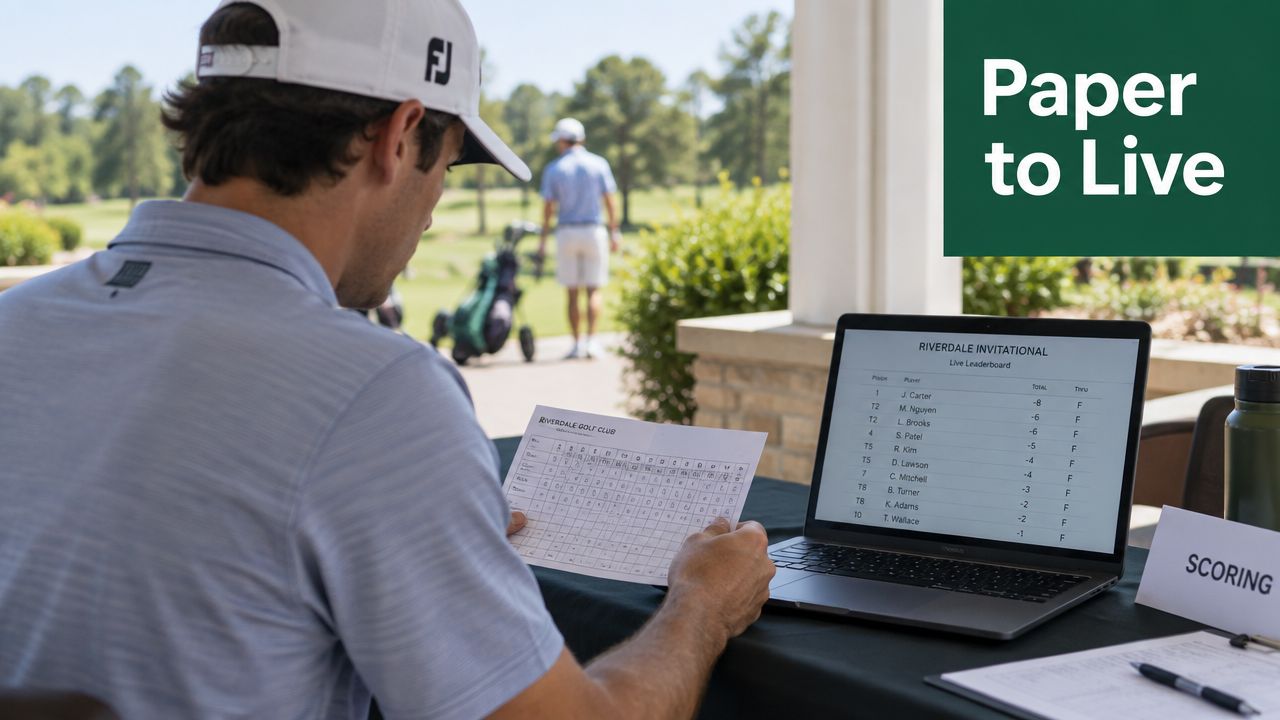
If you manage events with live scoring, Live Tourney's golf score tracking shows how score entry and leaderboard updates connect in a tournament setting. Live Tourney itself is one option for running those workflows, with web-based score entry and real-time leaderboards that line up naturally with the card in a player's hand.
Quick Tips and Common Scorecard Questions
Write in pencil, not pen, unless the event says otherwise. Check each hole with your marker before you move on, and don't wait until the clubhouse to sign. The card should be legible, totals should match, and both signatures should be on it before anyone calls the round complete.
A few common questions come up in almost every first event:
What if a hole isn't finished before darkness? Follow the tournament's local rule or committee instruction, then mark the score exactly as directed. The important part is not guessing.
How do maximum-score rules work? Formats that use Net Double Bogey cap the score you record for handicap purposes, so the card may not show every stroke exactly as played for posting.
Do I write a provisional on the same line? Usually not unless the event format or committee asks for it. Keep the main score line clean and use the prescribed area if there is one.
What about Stableford? Stableford replaces raw stroke totals with points, so the same hole-by-hole discipline still matters, even though the final math changes.
The larger habit is simple. Keep the paper clean, confirm every hole as you go, and your digital scoring will usually stay clean too.
If you're running tournaments, leagues, or outings, Live Tourney gives you a straightforward way to tie the scorecard to real-time scoring and live leaderboards without making staff or players wrestle with clunky software. Visit Live Tourney to see how the same hole-by-hole discipline from the paper card can carry into a modern event workflow.