
Dec 23, 2025
Master golf tournament scoring with our complete guide. We explain formats like Stroke Play, handicaps, and digital solutions to make scoring simple.
Scoring a golf tournament isn't just about adding up shots—it's about knowing which game you're playing. The two big ones are Stroke Play, where the lowest total score wins, and Match Play, a head-to-head battle where you win by taking more holes than your opponent.
Knowing which system is in play is the first step to understanding what's actually happening out on the course.
How Golf Tournament Scoring Actually Works
Think of it like different card games. Poker and Rummy use the same 52-card deck, but the rules for winning are completely different. Golf is the same way. The scoring format completely changes the strategy, the pressure, and the excitement of an event.
At its heart, tournament scoring is just the framework that turns a player's performance into a final ranking. Hitting the ball into the hole is always the goal, but the format decides which shots matter most. This variety is what makes tournament golf so much fun, allowing for everything from steady, conservative rounds to bold, high-risk strategies.
The Foundational Pillars of Golf Scoring
Nearly every golf tournament is built on one of a few core scoring systems. These are the "operating systems" for the event, and getting the basics down is essential for any player, organizer, or even just a fan trying to follow along.
Here are the three most common formats you'll run into:
Stroke Play: This is golf in its purest form and what you see in most professional tournaments. Every single shot counts toward a cumulative total. The winner is simply the player with the lowest score at the end. It's a marathon, not a sprint.
Match Play: This is a head-to-head duel. Players or teams compete to win individual holes, and the overall score is irrelevant. The only thing that matters is winning more holes than your opponent. It's a series of 18 one-hole sprints.
Stableford: A points-based game that rewards aggressive play. Instead of counting shots, you earn points based on your score for each hole (e.g., a birdie might be worth 3 points, a par 2 points). Higher scores are better, which means one disastrous hole won't sink your entire round.
These formats create totally different competitive vibes. A grinder who excels at the steady consistency of Stroke Play might get picked apart in the hole-by-hole showdowns of Match Play.
To give you a clearer picture, let's put these three pillars side-by-side.
Key Golf Scoring Formats at a Glance
This table breaks down the core differences between the main scoring formats, giving you a quick reference for how each one works.
Scoring Format | Primary Objective | Competitor Focus | Scoring Unit |
|---|---|---|---|
Stroke Play | Achieve the lowest total score over all holes. | Consistency and minimizing mistakes across the entire round. | Total shots taken. |
Match Play | Win more individual holes than the opponent. | Winning the current hole, regardless of the overall score. | Holes won or lost. |
Stableford | Accumulate the highest number of points. | Maximizing points on each hole by taking calculated risks. | Points awarded per hole. |
Understanding these basics is your roadmap to figuring out how scores are calculated, verified, and finalized in just about any tournament you'll encounter.
The Most Common Golf Scoring Formats Explained
Now that we’ve covered the basics of scoring, let’s get into the different ways a tournament can be played. The format you choose completely changes the feel and strategy of the event, which is why a casual charity scramble feels so different from the final round of a major championship.
Some formats are all about consistency and patience. Others reward aggressive, high-risk play. Knowing the difference is key to setting up a great event or just understanding what you're watching on TV.
This graphic breaks down the core ideas behind the three main formats you'll run into: Stroke Play, Match Play, and Stableford.
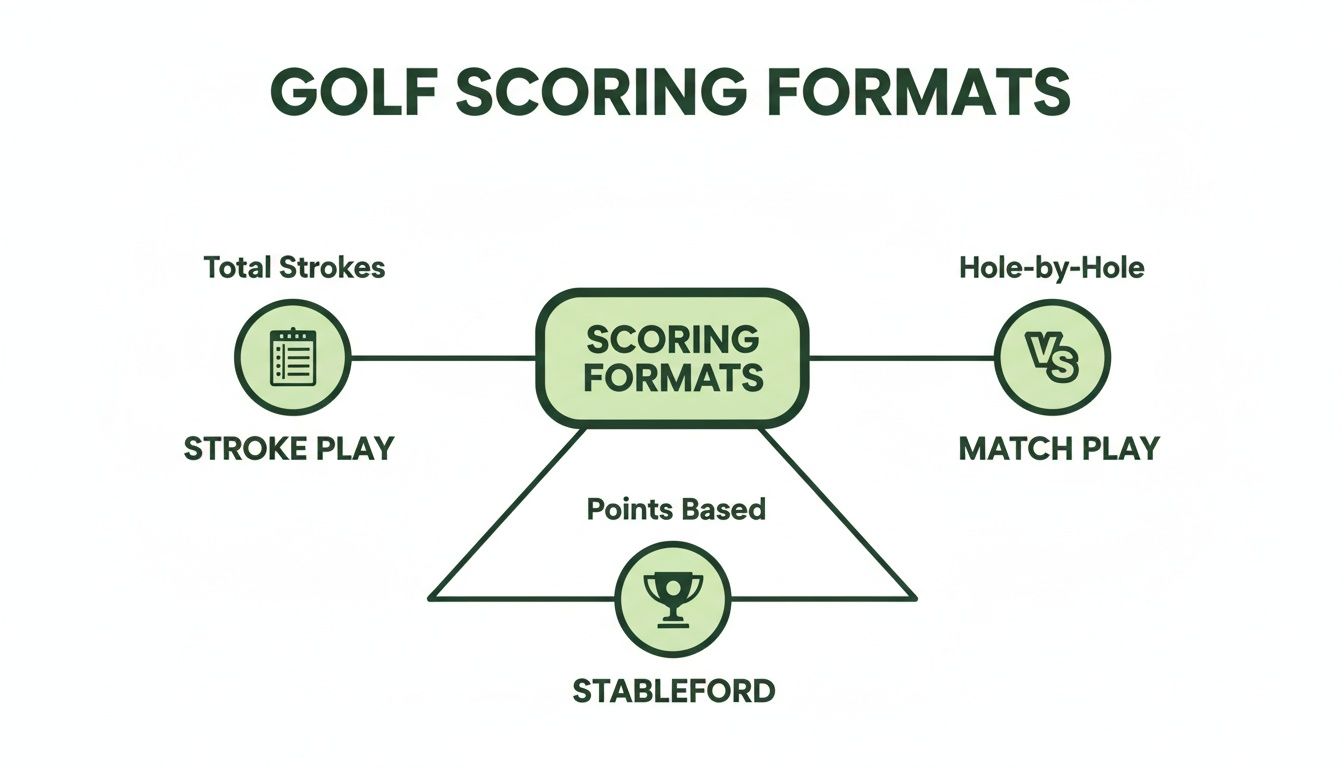
As you can see, Stroke Play is about the total shot count, Match Play is a head-to-head battle for holes, and Stableford is all about racking up points.
Stroke Play: The Marathon of Consistency
Stroke play is the format most people know, especially from professional golf. The goal couldn't be simpler: play a set number of holes in the fewest possible shots. That’s it. Every single stroke counts, from the first drive of the day to the very last putt.
This format is a true mental grind. One disastrous hole—a triple bogey or worse—can wreck your entire tournament because you have to carry that score with you. There's nowhere to hide from a big number.
The beauty of stroke play is its purity. The leaderboard gives you a crystal-clear look at who played the best golf from start to finish. This is what creates such incredible drama at major championships like the U.S. Open, where the pressure builds with every shot. Rory McIlroy’s 2011 victory at 16-under par 268 is a perfect example of what it takes to win. You can see how the winning scores have changed over the years on the official U.S. Open history page.
Match Play: The Head-to-Head Duel
If stroke play is a marathon, then match play is a series of 18 one-on-one sprints. Here, two players (or two teams) are competing to win individual holes. The total score for the round doesn't matter; all that counts is who shoots the lower score on each hole.
The score is kept in terms like "1 up," "2 down," or "all square." The match ends when one player is ahead by more holes than are left to play. A "3 and 2" victory means a player was three holes up with only two left, making it impossible for their opponent to catch up.
Key Takeaway: Match play rewards gutsy, go-for-broke golf. You could make a 10 on a hole, but if your opponent makes an 11, you still win. A bad hole is forgotten the moment you step onto the next tee.
This is the format that makes events like the Ryder Cup so electrifying. It's packed with dramatic momentum swings you just don't see in stroke play.
Stableford: The Points-Based Game
The Stableford format flips traditional scoring on its head. Instead of counting strokes to get the lowest score, you’re trying to earn points to get the highest score. Points are awarded on each hole based on your score relative to par.
A common Stableford points system looks like this:
Double Bogey or worse: 0 points
Bogey: 1 point
Par: 2 points
Birdie: 3 points
Eagle: 4 points
This system encourages you to play aggressively because the penalty for a bad hole is minimal. If you have a blow-up hole, you just get zero points and move on, knowing you can make up for it with a birdie on the next. It’s a great format for club events because it keeps things fun and helps speed up play.
Popular Team Variations
Beyond the individual formats, a ton of tournaments use team-based scoring. These are perfect for creating a more social, collaborative vibe, especially at charity fundraisers and corporate outings.
Scramble (or Captain's Choice)
In a scramble, everyone on the team (usually four players) hits a tee shot. The team picks the best one, and everyone hits their next shot from that spot. You repeat this process all the way to the hole. It's fantastic for groups with mixed skill levels because it takes the pressure off any one player and lets everyone contribute.
Skins Game
A Skins game is all about winning holes outright. Each hole is worth a prize, or a "skin." To win the skin, you have to have the single lowest score on that hole. If two or more players tie, the skin carries over to the next hole, making the pot bigger and the pressure higher. It’s a format built for exciting, winner-take-all moments.
Understanding Gross Score Versus Net Score
If you’ve ever played in a golf tournament that wasn’t packed with scratch professionals, you’ve heard two terms thrown around constantly: gross score and net score. Getting the hang of these is key to understanding how amateur golf works, because it’s the very system that lets players of all skill levels compete on a level playing field.
Think of your gross score as your raw, unfiltered performance. It's the simplest metric in golf—the actual number of strokes you took to complete your round. If you shot a 90, your gross score is 90. It’s a straight-up measure of how you played that day, with no funny business or adjustments.
But if tournaments only used gross scores, they’d just be a competition between the handful of elite players who show up. This is where the net score comes in to play the role of golf’s great equalizer.
Simply put, the net score is a player's gross score minus their handicap strokes. This is the magic that makes golf so inclusive, allowing a weekend hacker to have a legitimate, exciting match against the club champion.
What Is a Handicap and How Does It Work?
A golf handicap is just a number that represents a player's potential ability. The lower the number, the better the player. A Course Handicap is more specific—it’s the number of strokes a player gets on a particular course, playing from a specific set of tees.
This number isn't just pulled out of thin air. It’s calculated using a player's Handicap Index (a measure of their general skill) and factoring in the difficulty of the course they're playing that day, which is based on its Course Rating and Slope Rating.
A player’s handicap is essentially a performance benchmark. It ensures that a golfer is competing against their own potential, as well as against the rest of the field.
This adjustment is what creates a fair fight. It bridges the gap between the guy who consistently shoots in the 70s and the one who’s just hoping to break 100. On tournament day, the net score becomes the real measure of who played best relative to their own ability.
Calculating Net Score Step by Step
Let's walk through a quick example to see how this works in the real world. Imagine two players, Alex and Ben, are facing off in a stroke play event.
Alex is a solid golfer with a Course Handicap of 5.
Ben is more of an intermediate player with a Course Handicap of 18.
At the end of the round, their gross scores are in. Alex shot a respectable 78, while Ben had a fantastic day and posted a 92. Looking at gross scores alone, Alex wins by a mile—14 strokes, to be exact. But the net score tells a totally different story.
To find their net scores, we just subtract their handicaps.
Alex's Net Score: 78 (Gross Score) - 5 (Handicap) = 73
Ben's Net Score: 92 (Gross Score) - 18 (Handicap) = 74
Once the handicaps are applied, the competition is suddenly razor-thin. Alex squeaks out the win by just one stroke. This shows how the system rewards Ben for playing so much better than his average, making the tournament exciting for everyone.
To make it even clearer, let's look at how the math shakes out for a few different players.
Gross Score vs Net Score Calculation Example
Here’s a simple table showing how the net score is calculated, and how it can completely change the tournament outcome.
Player | Gross Score | Course Handicap | Calculation | Net Score |
|---|---|---|---|---|
Player A | 82 | 10 | 82 - 10 | 72 |
Player B | 90 | 15 | 90 - 15 | 75 |
Player C | 95 | 24 | 95 - 24 | 71 |
In this scenario, Player C, who shot the highest gross score by a wide margin, actually ends up winning the tournament with the lowest net score of 71. This is exactly why net scoring is the backbone of amateur golf all over the world.
Navigating the Scorecard and Avoiding Common Mistakes
In golf, a signed scorecard is more than just a piece of paper—it’s a binding contract. Once you’ve signed and handed it in, those scores are locked in for good. An honest mistake can have serious consequences, potentially turning a career round into a disqualification.
Knowing your way around a scorecard is just as crucial as sinking a putt on the 18th.

Think of the scorecard as your official testimony for the round. It holds all the key data: hole yardages, pars, and the empty boxes waiting for your scores. Your job is to make sure every number is a true reflection of your play, and that requires a bit of teamwork between you and your playing partner.
The Player and the Marker Roles
In any official tournament, two roles are essential for keeping golf tournament scoring accurate: the "player" and the "marker."
The Player: That's you. You are ultimately responsible for making sure the score for each hole is correct before you put your signature on the card.
The Marker: This is a competitor in your group who keeps your score. They're tasked with recording your score on each hole and confirming it with you as you play.
After the round, you and your marker review the scorecard together. Once you both agree that the hole-by-hole scores are right, you each sign it. The marker’s signature "attests" to the score, and yours confirms it. It’s the game’s built-in defense against errors.
A player is responsible for the correctness of the score recorded for each hole on their scorecard. If they return a scorecard with a score for any hole lower than actually taken, they are disqualified. If the returned score is higher, the higher score stands.
This rule gets to the heart of the game's integrity. There’s zero wiggle room if you sign for a lower score, which is why a final, thorough check before you leave the scoring area is non-negotiable.
Costly but Common Scoring Mistakes
Even with a system of checks and balances, mistakes happen. Knowing the common pitfalls is the best way to avoid them and protect your score.
Here are the critical errors to watch out for:
Simple Math Errors: It’s the most common mistake in the book—adding up the front nine and back nine incorrectly. Always use a calculator or have someone else double-check your addition.
Signing for a Lower Score: This is the cardinal sin of scorecard management. Signing for a 4 on a hole where you actually made a 5, even by accident, results in an immediate disqualification.
Forgetting to Sign: An unsigned scorecard is an incomplete one. It can also lead to disqualification, so make sure both you and your marker have signed in the right spots.
Transposing Scores: It’s surprisingly easy to write a score on the wrong hole, especially when you're moving quickly. A good habit is to verbally confirm your score with the marker right after you finish each hole.
At the end of the day, your scorecard is your responsibility. Take an extra minute or two after your round to carefully look over every number. That diligence is what ensures the golf tournament scoring is fair, accurate, and a true reflection of everyone's performance.
How Tie-Breakers and Special Rulings Work
A tie at the top of a leaderboard creates a unique kind of tension. When two or more players finish with the same score, you’ve got to have a fair way to decide on a clear winner. The method you use can range from a quiet, behind-the-scenes calculation to a dramatic, high-stakes showdown that keeps everyone holding their breath.
The Scorecard Playoff
The most common method, especially in amateur events and club leagues, is the scorecard playoff, often called a "countback." This is a paper-and-pen solution where tournament officials simply compare the tied scorecards. The winner is determined by who played better on the back nine (holes 10-18).
If the players are still tied, the comparison shrinks to the last six holes, then the last three, and finally, just the 18th hole. It’s a clean, systematic way to declare a winner without making everyone play more golf.
The Sudden-Death Playoff
In the pros and major championships, however, the solution is far more exciting: the sudden-death playoff. Tied players head right back out to the course to play extra holes. The first player to win a hole outright wins the entire tournament. This format is where legends are made, and a single great shot—or one costly mistake—can decide a championship.
There's nothing quite like the pressure of a sudden-death playoff. It’s a pure test of nerve where players have to execute perfectly when it matters most.
Understanding Special Rulings and Penalties
Beyond ties, things happen on the course that can add penalty strokes and change a player's score. Understanding these rules is crucial for accurate scoring. They aren't just there to be punitive; they exist to keep the game fair when a ball ends up in a tough or unplayable spot.
Here are a few common situations that add strokes:
Out of Bounds (OB): If a shot lands outside the course boundaries (marked by white stakes), the player gets a one-stroke penalty and has to replay the shot from the original spot.
Lost Ball: A player gets three minutes to find their ball. If it can't be found, the penalty is the same as out of bounds: stroke and distance.
Unplayable Lie: If your ball is in a spot where you physically can't make a swing (think deep inside a bush), you can declare it unplayable. This gives you several relief options, but each one will cost you a one-stroke penalty.
The relentless pressure of professional golf has produced some legendary champions who mastered both the rules and the competition. Jack Nicklaus holds the all-time record with 18 major championship victories, a testament to his incredible consistency and mental toughness under fire.
From 1960 to 1980, Nicklaus racked up 51 top-five finishes in majors—more than double the next best player. His dominance completely redefined what was possible in the sport. You can learn more about the incredible stats behind Nicklaus's legendary career on the PGA TOUR site.
Whether you’re facing a scorecard playoff or a tricky penalty situation, knowing the rules gives you the confidence to handle any challenge the course throws at you.
The Shift to Digital and Live Golf Scoring
Remember huddling around a giant scoreboard, waiting for the last group to walk in with their paper cards? Those days are quickly becoming a memory. Modern golf tournaments have moved away from manual calculations and delayed results, embracing the instant feedback of live, real-time scoring.
This isn't just about convenience. It’s a fundamental change in how players, organizers, and even spectators experience the game.
Digital platforms and mobile scoring apps do all the heavy lifting. The second a player punches in their score on a phone, it syncs to a central leaderboard, updating the standings for everyone to see. This completely removes the tedious—and often error-prone—job of collecting and adding up scores after the round.

The interface is clean and simple, letting players enter scores right on the course. That immediate feedback and access to a live leaderboard just makes any event feel more professional and engaging.
The Power of Real-Time Leaderboards
By far the biggest advantage of digital scoring is the live leaderboard. Instead of playing in a bubble, golfers know exactly where they stand against the field at any moment. It brings a dynamic, competitive feel that used to be reserved for the pros.
A live leaderboard changes the game in a few key ways:
Builds Excitement: Players know exactly what they need to shoot on the final holes. This creates way more drama and strategic thinking down the stretch.
Engages Everyone: Spectators and folks back at the clubhouse can follow the action from anywhere, turning a simple tournament into a much more interactive experience.
Speeds Things Up: With results calculated instantly, you can get to the awards ceremony and prize giving almost immediately. It saves a ton of time for staff and players alike.
Streamlining Tournament Management
Beyond the on-course buzz, these digital tools are a lifesaver for tournament organizers. Modern platforms are more than just scorekeepers; they're complete management systems that simplify everything from setup to final reporting. If you're new to this, it’s worth looking into what dedicated golf tournament management software can do for you.
Live scoring platforms can reduce the post-round workload for golf staff by over 90%. What once took hours of painstaking manual entry now takes just a few minutes of review.
This lets your staff focus on creating a great player experience instead of being buried in administrative work. That’s a huge deal for running a polished, modern event.
This kind of real-time data also opens the door to deeper analysis. For a little perspective, think about Jack Nicklaus's U.S. Open dominance from 1966 to 1982, where he averaged an incredible 3.41 Strokes Gained: Total per round. This kind of detailed stat, once reserved for historians, is now becoming accessible to everyday tournaments.
To see how technology is continuing to push the game forward, check out this piece on TGL's star power and technological advancements. The shift from paper to pixels is making golf at every level more exciting and efficient.
Common Questions About Golf Scoring
Even when you feel like you've got a handle on the basics, golf scoring has its quirks. Let's clear up a few of the most common questions that pop up during tournaments.
What’s the Easiest Scoring Format for Beginners?
The Scramble format is, without a doubt, the best way to introduce new players to tournament golf. It's built for fun and takes the pressure way down.
Here's how it works: everyone on the team tees off, the team picks the best shot, and everyone plays their next shot from that spot. This simple process repeats all the way to the hole.
A beginner never has to sweat a bad shot because a teammate can always bail them out. It’s all about teamwork and having a good time, which is exactly what a first tournament experience should be.
How Is a Course Handicap Different from a Handicap Index?
This one trips up a lot of people, but a simple analogy makes it clear. Think of your Handicap Index as your overall GPA—it’s a portable, standardized measure of your potential skill, calculated from your most recent rounds. It goes wherever you go.
Your Course Handicap is how that GPA gets adjusted for a specific "test"—the course you're playing today. A tough, highly-rated course might give you a few extra strokes, while an easier one will give you fewer. It’s the number of strokes you actually get for that specific round.
In short: Your Handicap Index is what you are. Your Course Handicap is what you get on a given day to level the playing field.
What Happens If I Sign for a Wrong Score?
The Rules of Golf are incredibly strict here, and for good reason—it protects the integrity of the game. What happens next depends entirely on the type of mistake you made.
Signing for a Lower Score: If you sign for a score on any hole that's lower than what you actually made, the penalty is disqualification. It doesn't matter if it was an honest mistake.
Signing for a Higher Score: If you sign for a score that is higher than you actually shot, that higher score stands. No penalty, but you’re stuck with it.
This rule is why you should always, always double-check your scorecard with your marker before you sign it. Once that card is turned in, it's final.
Ready to run your next event with flawless, real-time scoring? Live Tourney makes tournament management effortless. Ditch the paper scorecards and manual calculations for a modern, app-free platform that players and staff will love. Start your free trial today and see how easy running a professional-grade golf tournament can be. https://livetourney.com





