Aug 9, 2026
golf course management, golf operations, tournament software, course maintenance, golf KPIs
Learn what golf course management really involves — operations, agronomy, staffing, finances, and events — plus KPIs and modern tools that make it work.

If you've ever started a Tuesday with a wet fairway, a half-open tee sheet, a member asking why the greens are slow, and a charity outing due before lunch, you already know the truth: golf course management isn't a turf job, it's a triage job. You're balancing course conditions, staffing gaps, revenue gaps, and a dozen people who all think their issue is the urgent one.
That's why the old way falls apart. The old way treats agronomy, the pro shop, the starter, tournament prep, labor scheduling, and member communication like separate worlds. They're not separate. One weak link shows up in pace of play, then in complaints, then in fewer bookings, then in a rougher week for revenue.
A Day in the Life of a Modern Golf Course
Tuesday starts before sunrise. The superintendent is already on the grounds, the head pro is looking at a tee sheet with empty blocks that should've been sold, and the first panic of the day is a cart staff callout. By 8 a.m., somebody wants to know if the wet fairway can stay closed, somebody else wants pairings printed for a charity outing, and a member is already unhappy about green speed.
That's normal. That's the job.
A 36-hole facility makes the pressure obvious because nothing sits still for long. The same morning can include a sold-out outing on one side, open inventory on the other, a maintenance delay, and a staff shortage. If the shop does its job but agronomy misses the mark, golfers still remember the round as slow or rough. If the course is perfect but the tee sheet is poorly managed, revenue leaks anyway.
Practical rule: Run the course like a series of connected handoffs, not isolated departments. If one team doesn't know what the next team needs, the golfer pays for it.
The hardest part isn't a single task. It's the overlap. Tee-time spacing affects pace of play. Pace of play affects mood. Mood affects reviews, rebookings, and how forgiving people are when the greens aren't perfect. That's why serious operators stop talking about “maintenance” as if it's only mowing. It's customer flow, labor allocation, and communication under pressure.
I'd rather run a course with a tight process and a few visible compromises than a course with pretty turf and sloppy coordination. Golfers forgive limits. They don't forgive confusion.
What Golf Course Management Actually Includes
Golf course management is six jobs that have to work together whether the staff is ready or not. Agronomy keeps the playing surfaces alive. Operations moves players through the day without chaos. Staffing makes sure the people are there to do the work. Finance decides what the operation can afford. Guest experience shapes what golfers remember. Events and tournaments turn the course into a revenue engine instead of just a place to play.
Agronomy and course conditions
The superintendent owns the turf, water, pests, and playability. If the greens are inconsistent, the whole operation feels cheap, even when everything else is polished. Poor course conditions don't stay in the grounds crew lane, they spill into pace of play, complaints, and bookings.
Daily operations
The head pro, GM, starter, and shop team own the tee sheet, cart flow, check-in, pace control, and the handoffs between golfers and the course. If this part is sloppy, the rest of the facility spends the day putting out avoidable fires. Good operations make a busy day feel controlled.
Staffing
Labor is not just a cost line. It's the ability to execute the standard you promised. If the cart staff is short, if the outside service team is undertrained, or if the pro shop is understaffed during a tournament, the golfer notices immediately.
Finance
Money decisions set the ceiling. You can't pretend every acre deserves the same attention when water, labor, and weather are all squeezing the budget. That's where a realistic management plan beats a fantasy one.
Guest experience
This covers booking, check-in, communication, follow-up, and the little moments that shape trust. A clean answer on the phone matters. So does clear signage, fast issue resolution, and a round that starts on time.
Events and tournaments
Outings, leagues, and tournaments are where systems get exposed. If the workflow is broken, it shows up in pairings, live scoring, cart signs, payout sheets, and post-event communication.
For operators who want a practical public-facing example of how outdoor property support gets organized, property managers lawn service is a useful reference point for the service mindset behind steady upkeep. The point is simple, good management is coordination, not heroics.
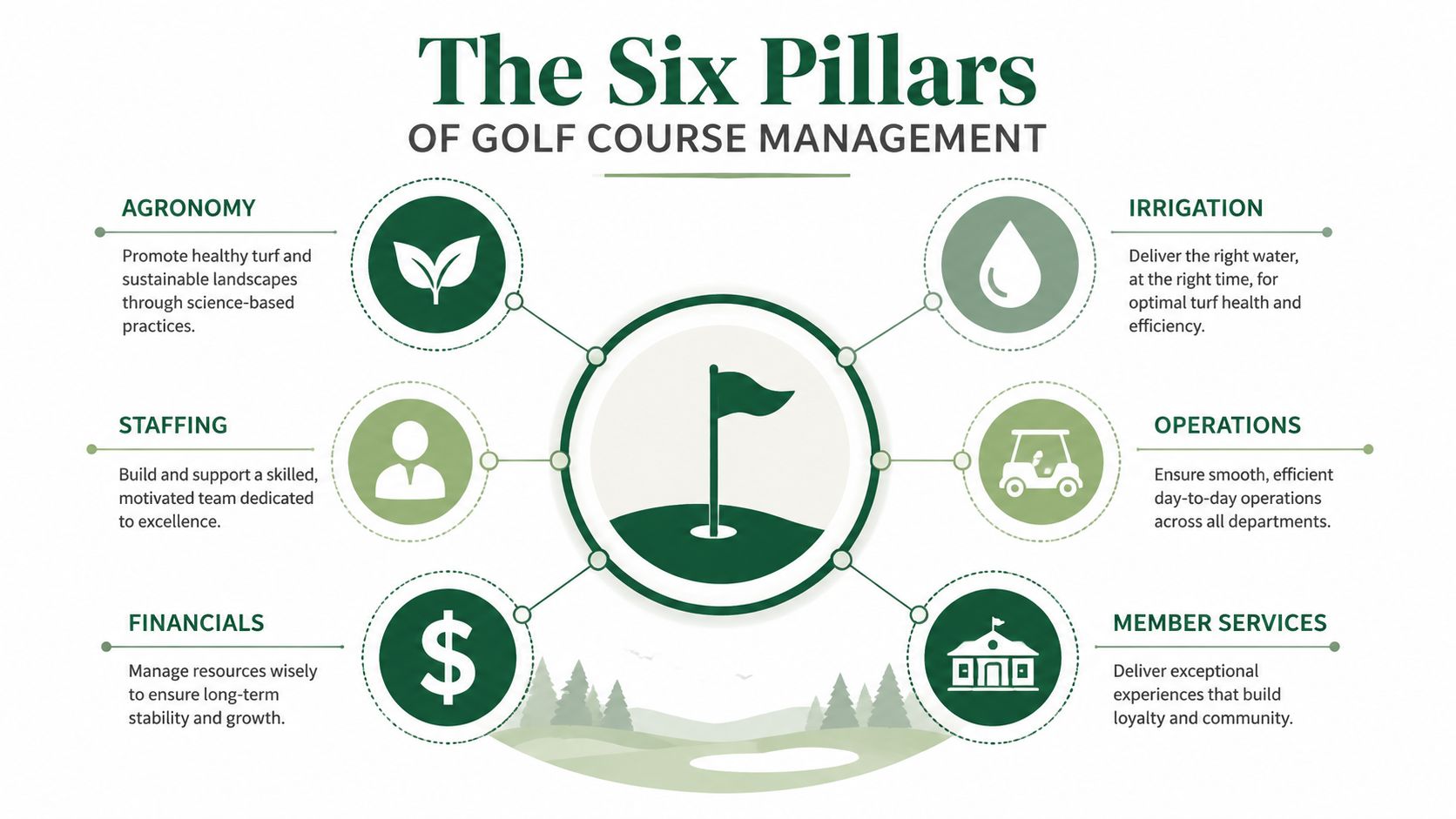
A lot of operators still buy software and hire people as if these six jobs don't touch each other. They do. Fragmented tools create fragmented decisions, and fragmented decisions create friction for golfers and staff alike.
Agronomy and Course Maintenance Essentials
The superintendent's job is a constant set of tradeoffs. Soil, water, turfgrass species, pests, labor, and traffic all pull against one another, and the course only plays well when those pressures are managed with discipline. Reducing agronomy to “keep it green” is lazy management, and it misses the point that maintenance choices are really triage choices under real constraints.
Greens deserve the most attention
Greens get the first call because they drive the round. The USGA puts greens at the center for a reason, they account for 80% of shots in a typical round (USGA). If the putting surfaces are off, every other improvement feels smaller than it should. Golfers will live with a bunker that needs attention or a fairway that is a little thin, then lose patience the second they do not trust a putt.
The right KPI bundle for greens is speed, clipping volume, firmness, smoothness, and trueness. That set matters because it ties what players feel to what the crew can control. The USGA also recommends measuring speed on the same green and same locations each time, with two marked points about 9 to 12 feet apart on a relatively flat area, so the reading stays consistent instead of turning into guesswork.
Practical rule: If you cannot measure it in the same place every time, you are not managing it. You are guessing.
Clipping volume is usually the better read than clipping weight when sand contamination is in play. Weight gets distorted, volume tells you more about what the turf produced. That kind of detail helps a superintendent explain why a mowing change, a growth regulator decision, or an irrigation adjustment mattered, and it gives ownership something better than a hand-wave when conditions shift.
Track inputs with outputs
The R&A's evidence-field framework is the right model for operators who want proof, not opinion, because it ties turf response to what was done in the field. It calls for monitoring on at least 3 greens, while recording moisture content, firmness, speed, and trueness/smoothness alongside inputs like weather, irrigation volume, pesticide use, fertilizer rate, energy use, waste disposal, and hours worked by course area (R&A evidence-field framework). That is not bureaucracy. It is the only way to defend a maintenance budget with evidence when the weather, staffing, and water supply are all pressuring the operation.
Weekly reporting on mowing heights, verticutting, topdressing, wetting agents, growth regulator use, overseeding, and aeration creates the trail you need when ownership asks why conditions changed. If you are trying to rethink course layout or maintenance exposure, garden ai design is a reminder that planning tools now exist for the other side of the equation too. And if you want to connect turf decisions to routing, traffic, and maintenance efficiency, GPS systems for golf courses is worth a close look.
The broader point is simple. Agronomy is not a list of chores. It is a measurable system, and the operators who treat it that way make better decisions about water, labor, and the conditions that move rounds and revenue.
Operations, Staffing, and Financial KPIs
Operations is where the day works or falls apart. Tee-sheet management, pace of play, cart fleet readiness, food and beverage, the pro shop, and member services all sit in one system. If one piece is slow, the entire facility feels it.
The first number to watch is occupancy/utilization, measured as rounds played divided by total available rounds or tee times (Antonio Gómez Cava KPI framework). That tells you whether you are selling the inventory you already own. A course can also post a healthy-looking day and still leave money on the table, which is why Revenue Per Available Tee Time matters too, measured as total revenue divided by available tee times.
What goes on the weekly dashboard
A serious operator does not need thirty metrics. They need a dashboard they will use.
Occupancy: Are tee times selling, or are they sitting empty?
RevPATT: Are available tee times producing enough revenue?
Average rate per round: Is pricing aligned with demand?
Labor discipline: Are staffing levels matching traffic?
Retention signals: Are regulars coming back, or drifting away?
Revenue per acre: Is the property producing enough for what it costs to maintain?
Those numbers should drive decisions, not decorate a report. If utilization is soft, adjust tee-time spacing, channel mix, and pricing. If labor is bloated, fix the schedule, cross-train the team, and stop staffing to ego instead of demand. If retention slips, repair service lapses before spending more on marketing.
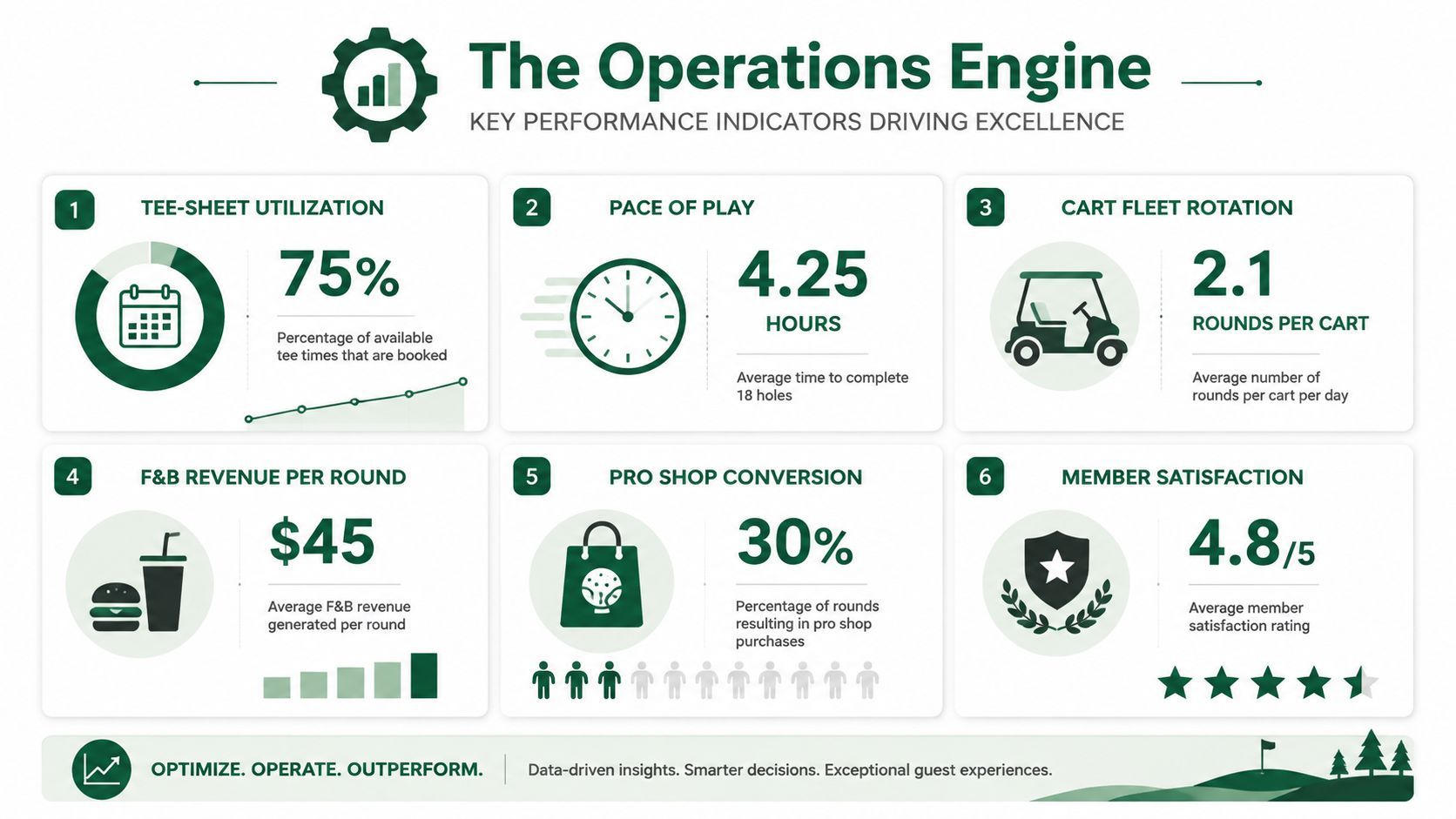
Cart fleets belong in the same conversation. The Solana EV fleet guide is useful if you are rethinking cart downtime, charging, and rotation. I care about one thing. Are the carts ready when golfers need them, and does the fleet support the pace you promised?
If a number does not change a staffing, pricing, or inventory decision, it does not belong on your report.
League play deserves the same discipline. A clear golf league program keeps recurring groups organized, reduces confusion at check-in, and gives staff a repeatable structure instead of a weekly scramble.
I would rather see a clean one-page operating sheet than a bloated spreadsheet nobody opens. Put the numbers where the head pro, superintendent, and GM can all act on them.
Guest Experience and Tournament Operations
The golfer experiences the operation through friction or ease. Booking a tee time, checking in, getting cart directions, starting on time, and walking away with a clear answer to questions, those are the moments that define whether your facility feels organized. The rest is background noise.
Tournament day is the best stress test because it compresses everything into one operating window. The pro shop builds pairings and tee sheets, the starter keeps the flow moving, the shop prints cart signs and bag tags, scoring has to stay current, side games need clean handling, and payouts can't be a mess at the end.
The tournament workflow that actually works
The staff has to own the sequence, not just the tasks.
Set the structure early. Lock the format, starting method, and field rules before anyone shows up.
Build the tee sheet cleanly. Pairings, gaps, and pace expectations need to be set before morning check-in.
Print the physical materials. Cart signs, bag tags, scorecards, and any sponsor pieces should be ready before arrivals.
Run check-in like a front door, not a bottleneck. Players should know where to go and what happens next.
Score in real time when possible. Waiting until the end creates confusion, especially in team formats.
Close the event with clarity. Side games, payouts, results, and follow-up emails should feel finished, not improvised.
That old world of clipboards, spreadsheets, and clunky systems wastes energy. Staff ends up doing duplicate work, players wait around, and simple tasks take longer than they should. A modern flow should let a player open a link on any phone, enter scores, see live results, and move on.
I'm not romantic about software, but I am ruthless about friction. If your league night or outing takes too long to set up, or your scoring process creates confusion, the operation is telling you the tools are wrong. The process should make the staff look organized, not busy.
The Real Challenges and How Operators Are Solving Them
Water, labor, and climate are the pressure points, and pretending otherwise is wasted energy. The USGA says those are the top current and future concerns, with water rising to the top or second place across most job and region breakdowns (USGA course maintenance challenges). That means the job is no longer just keeping turf healthy. It's deciding what to protect, what to reduce, and how to explain the tradeoffs.
Triage beats perfection
Public-course guidance from the USGA points operators toward primary playing areas, fewer maintained acres, reduced non-golf landscaping, and standards matched to available resources (USGA course maintenance challenges). That's the correct mindset. Don't pretend every ornamental area matters as much as greens and fairways. It doesn't.
The hard part is communication. Golfers can handle change if you tell them the truth and keep the core experience intact. What they can't handle is silent decline. If the bunker edges are rougher, say why. If a planting bed is being reduced, explain what it buys the course in water or labor.
Operator's rule: Protect the playing surfaces first, then trim everything that doesn't move the golf experience.
The industry has also shifted from golf-only facilities toward lifestyle clubs and event-driven revenue. In some markets, digital convenience now matters almost as much as course condition. That's uncomfortable for old-school operators, but it's real. Members and guests judge you by how easy the experience is, not by how much effort your staff had to spend behind the scenes.
If I were advising a board this season, I'd say this. Pick the areas you will maintain at a high standard. Cut the acreage you can't justify. Tell golfers what changed and why. Then back it up with the data you're already collecting.
How Modern Software Fits Into the Operation
Software should cut friction, not create a second job for staff. Tee-sheet and POS systems belong in operations. Irrigation and labor tools belong in agronomy and staffing. CRM and email tools belong in guest experience. Tournament platforms belong in events, where the crew needs speed and clarity, not a maze of tabs.
The better systems fit the way a course runs under pressure. Staff need clean interfaces, mobile-friendly workflows, and support that answers fast. They do not want to train every volunteer or league captain on a legacy platform that feels built for an office cubicle.
I'll be blunt. The software you choose should make your worst day easier. If it cannot set up events quickly, handle live scoring cleanly, and keep players engaged without an app download, it is already behind. One modern option in this space is Live Tourney, which handles tournament setup, live scoring, registrations, and back-office materials for golf events. For operators comparing options, the right place to start is a practical buying guide such as best golf course management software, then match the tool to the event load you run.
The proof point that matters is simple. Live Tourney has powered 10,000+ events and 1M+ holes scored, delivering a 40% increase in live scoring participation and 3x faster setup compared with legacy tournament software (Live Tourney). That is the kind of gain you notice on a busy league night or a packed outing calendar.
For a purchase decision, start with your highest-friction event. Usually that is the weekly league. If the new workflow saves time there, it will scale to outings and member events. If it does not save time there, do not expect it to fix a bigger event.
Buying question is not whether the software has features. It is whether it cuts staff steps, shortens setup, and makes the golfer experience smoother. If it does not move those KPIs, rounds, check-in speed, event throughput, and repeat participation, it is just another screen for your team to babysit.
Common Questions From Course Operators
How often should you run tournaments before dedicated software makes sense? If event setup is recurring enough that staff are rebuilding pairings, signs, scoring, and emails by hand, the process is already expensive. My advice is simple, buy for the event cadence you have, not the one you wish you had.
What staffing ratio should a 36-hole daily-fee facility use? There isn't a universal ratio worth pretending is gospel. Match labor to traffic, service standards, and the amount of handoff work your operation creates. If carts, check-in, and event support feel thin on busy days, you're under-resourced where golfers notice it most.
What does environmental compliance really require? For pesticide applications, the EPA uses acreage-based adjustment factors, including 0.05 for tees and greens only, 0.29 for fairways only, 0.66 for roughs, 0.34 for tees, greens, and fairways, and 1.0 for tees, greens, fairways, and roughs (EPA adjustment factors). Report adjusted and unadjusted estimates where required, and don't guess.
What should you look for in a modern tournament platform? Speed, app-free scoring, clean registration, clear reporting, and support that doesn't disappear after purchase. If the system slows your staff down, it's the wrong system.
If you want tournament and league tools that help your staff move faster, keep scoring clean, and reduce the chaos around event day, take a look at Live Tourney. It's built for golf courses that need practical management tools, not another clunky platform to babysit.